
Class Support Plans: From Insight to Impact
Strengthening school support through data informed strategy, targeted class level support and early intervention. Identifying and addressing needs before they escalate
Schools are collecting more insight than ever about pupil wellbeing, experiences, and readiness for learning. The challenge is not gathering information, it is knowing how to use it effectively.
The YouCanSay Class Support Plan (CSP) approach bridges this gap by turning whole school survey data into clear, practical, and targeted support at class level, where it can have the greatest impact.
Why Focus on Class Level Support?
Much of the current system rightly focuses on identifying and supporting individual children with additional needs. However, many challenges experienced by pupils are shared across groups, often at class or year level.
By identifying patterns early, schools can:
- Provide support before issues escalate
- Address the needs of all pupils, not just a few
- Deliver support in a consistent and efficient way
- Reduce pressure on more resource intensive interventions
Class Support Plans are designed to complement existing provision, including SEND and pastoral support, by providing a preventative, whole class approach.
How CSP Complements SEND and Individual Support
Schools play a vital role in supporting children with additional needs, particularly through SEND provision and Education, Health and Care Plans (EHCPs). These approaches are essential in providing individual, tailored support for pupils with more complex or established difficulties.
However, individual support can be time intensive, specialist led, and resource heavy, meaning it is often focused on pupils whose needs have already become significant.
The Class Support Plan (CSP) approach provides a complementary layer of support by focusing on whole class and group level needs, identified through anonymous survey insight.
By identifying patterns early, CSPs enable schools to:
- Address emerging needs before they escalate
- Support all pupils within a class, not just individuals
- Deliver interventions in a consistent and manageable way
- Reduce future demand on more intensive SEND and specialist services
By acting early at class level, schools can often prevent smaller challenges from developing into more complex needs requiring intensive individual support.
In this way, CSPs and SEND provision work together as part of a graduated and balanced support system, combining early identification, whole class strategies, and individual intervention.
The CSP Approach
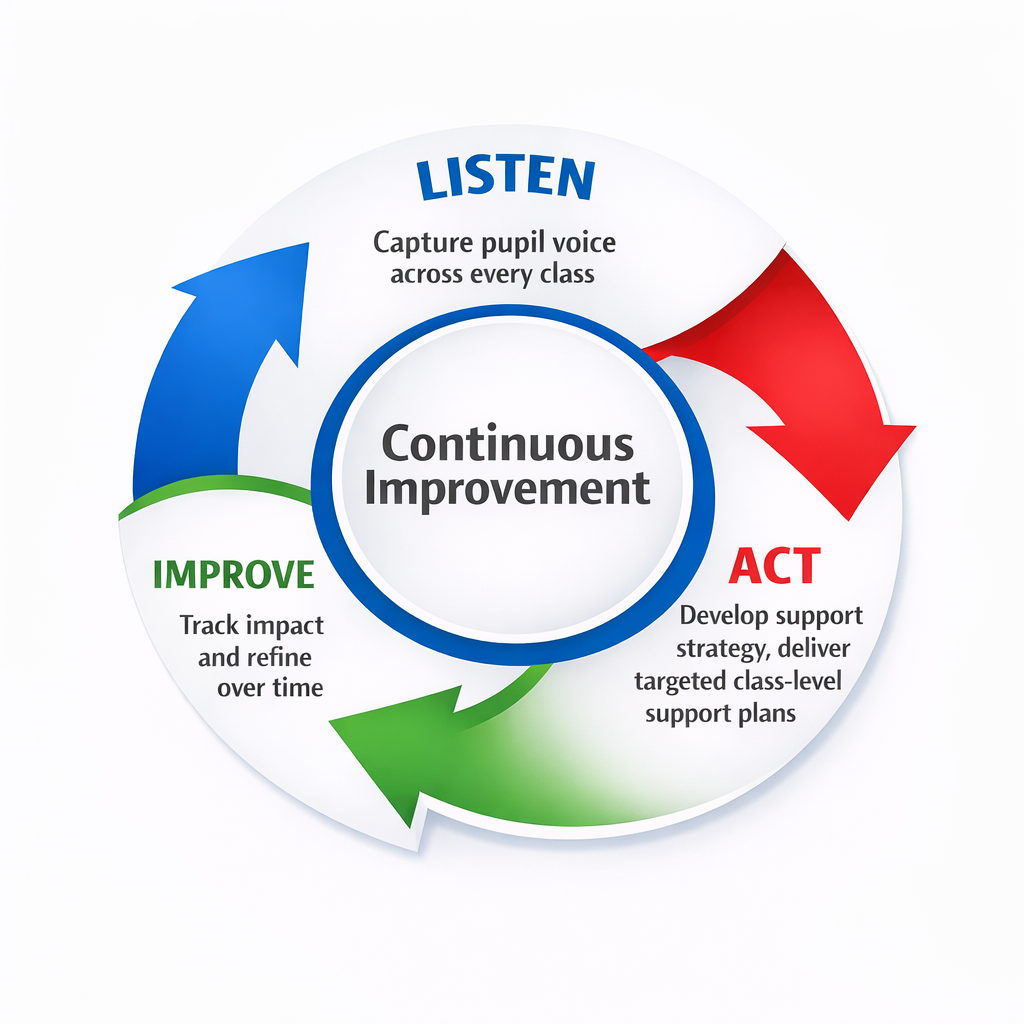
The CSP model follows a simple, evidence based cycle:
LISTEN → PRIORITISE → ACT → REVIEW → IMPROVE
1. Initial Questionnaire (Listen)
Using the YouCanSay surveys (e.g. Emotional Resilience, Life Readiness, or Pupils’ Voice), schools gather anonymous insight from pupils, and optionally parents and staff.
This provides a clear understanding of:
- Strengths and areas for development
- Differences between year groups, classes, and demographics
- Underlying factors affecting wellbeing, engagement, and readiness
2. Identifying Priorities (Prioritise)
Survey results are analysed automatically through the YouCanSay dashboard, highlighting key priority areas for each class.
Typically, schools focus on the top 3 priority areas where pupils are most in need of support.
3. Creating the Class Support Plan (Act)
Each class is provided with a clear, structured Class Support Plan (CSP), including:
- Key priority areas
- Suggested actions and interventions
- Frequency and delivery approach
- Review points
This ensures that support is: targeted, practical, and manageable for staff.
4. Delivering Support
Support is delivered through everyday school activity, such as:
- Tutor time or PSHE sessions
- Classroom strategies
- Group discussions and activities
- Pastoral support structures
5. Review Questionnaire (Review & Improve)
At the end of a defined period, schools complete a follow up survey to measure:
- Changes in priority areas
- Impact of interventions
- Remaining or emerging needs
This allows schools to demonstrate impact and refine their approach over time.
What Does a CSP Look Like?
A typical Class Support Plan includes:
- Class Profile: Overview of strengths and needs
- Full Results Summary: Scores across key factors
- Top Priorities: Focus areas for support
- Planned Actions: Practical strategies and activities
- Review Schedule: When progress will be assessed
- Impact Comparison: Before and after results
- Reflection and Next Steps
Benefits for Schools
- Early Intervention: Identify needs before they become issues
- Targeted Support: Focus on what matters most for each class
- Consistency: Structured approach across the whole school
- Efficiency: Supports many pupils at once
- Evidence of Impact: Clear before and after measurement
- Supports Ofsted Readiness: Demonstrates understanding and action
Supporting Schools Across Groups and Partnerships
Many schools are part of wider partnerships, including Multi-Academy Trusts (MATs), local authority boroughs, and school clusters. The Class Support Plan (CSP) approach can be extended across these groups to provide a broader, more meaningful understanding of pupil needs.
By aggregating survey data across multiple schools, it is possible to build a shared picture of strengths and priorities across the group, while fully maintaining the confidentiality of individual school results.
This wider perspective enables:
- Greater context: Schools can understand their results within the context of similar schools across the group
- Identification of strengths: Highlight where particular schools, year groups, or classes are performing strongly
- Sharing best practice: Learn from what is working well and apply successful approaches more widely
- Consistent strategy: Support the development of a coordinated, data-informed approach across the partnership
Aggregated insight also enables groups to understand the impact of wider health and wellbeing strategies. By bringing together results from across schools, leaders can assess whether group-wide initiatives are driving measurable improvement, identify where progress is strongest, and recognise where further support or refinement may be needed.
This approach moves beyond isolated insight, helping groups of schools to work collaboratively, learn from each other, and deliver more effective and consistent support for all pupils.
By combining insight at both school and group level, the CSP approach enables not just improvement within schools, but continuous improvement across entire systems.
Turning Insight into Impact
The YouCanSay platform enables schools to move beyond data collection and into meaningful action.
By combining high quality insight with structured Class Support Plans and measurable review processes, schools can create a continuous cycle of improvement that supports every pupil, in every class.