
From Insight to Impact: Strengthening School Support Through Data-Informed Strategy
Understanding the Challenge
Schools today are expected to meet a wide range of pupil needs, from general wellbeing and development through to complex special educational needs.
Significant progress is being made through Education, Health and Care Plans (EHCPs), and the development of individual support plans. These approaches play a vital role in formally validating a child’s needs and setting out the support required for special educational needs and disabilities (SEND).
However, they are also resource-intensive, time-consuming, and necessarily focused on individual pupils.
While individual plans provide depth, schools still need a way to understand patterns of need across all pupils, so that support can be prioritised effectively.
The Missing Layer: From Individual Need to School-Level Strategy
In practice, most schools are not lacking interventions. They are lacking clarity on what to prioritise, where need is greatest, and how needs differ across cohorts and classes.
All children are different, and all schools are different. Needs can vary significantly by year group, gender, background, cohort, and even between individual classes.
- One class may benefit most from developing strong, healthy relationships
- Another from building self-esteem
- Another from fostering positivity and sense of purpose
Without structured insight, these differences are often assumed rather than understood, addressed inconsistently, or missed entirely.
A Structured Solution: EHCS, SSS and CSP
1. Education, Health and Care Strategy (EHCS)
A whole-school strategic framework that identifies patterns of need across the pupil population.
2. School Support Strategies (SSS)
School-level priorities derived from EHCS insight, defining the key areas of focus and strategic direction of support provision.
3. Class Support Plans (CSP)
The practical application of strategy at class level, translating insight into targeted and manageable actions tailored to each class.
4. Individual Plans and EHCPs
These remain essential for pupils with identified or higher-level needs where individualised support is required.
EHCPs and individual plans provide depth (individual need), while CSPs and SSS provide breadth (population need).
How Insight is Gathered
A key question is how schools reliably understand need at this level. The answer lies in structured, anonymous insight gathering across the whole school population.
- Pupil voice surveys
- Parent/carer input
- Staff insight (e.g. form tutor perspective)
This enables every pupil to contribute to a shared understanding of need, rather than relying solely on identified cases.
Areas of Insight: Life Readiness and Resilience
- Self-Understanding – Knowing Yourself
- Understanding Others – Connecting with People
- Emotional Management & Coping – Handling Life’s Challenges
- Purpose, Positivity & Forward Direction – Looking Ahead
These areas reflect the foundations of emotional resilience, wellbeing, and life readiness.
From Data to Action
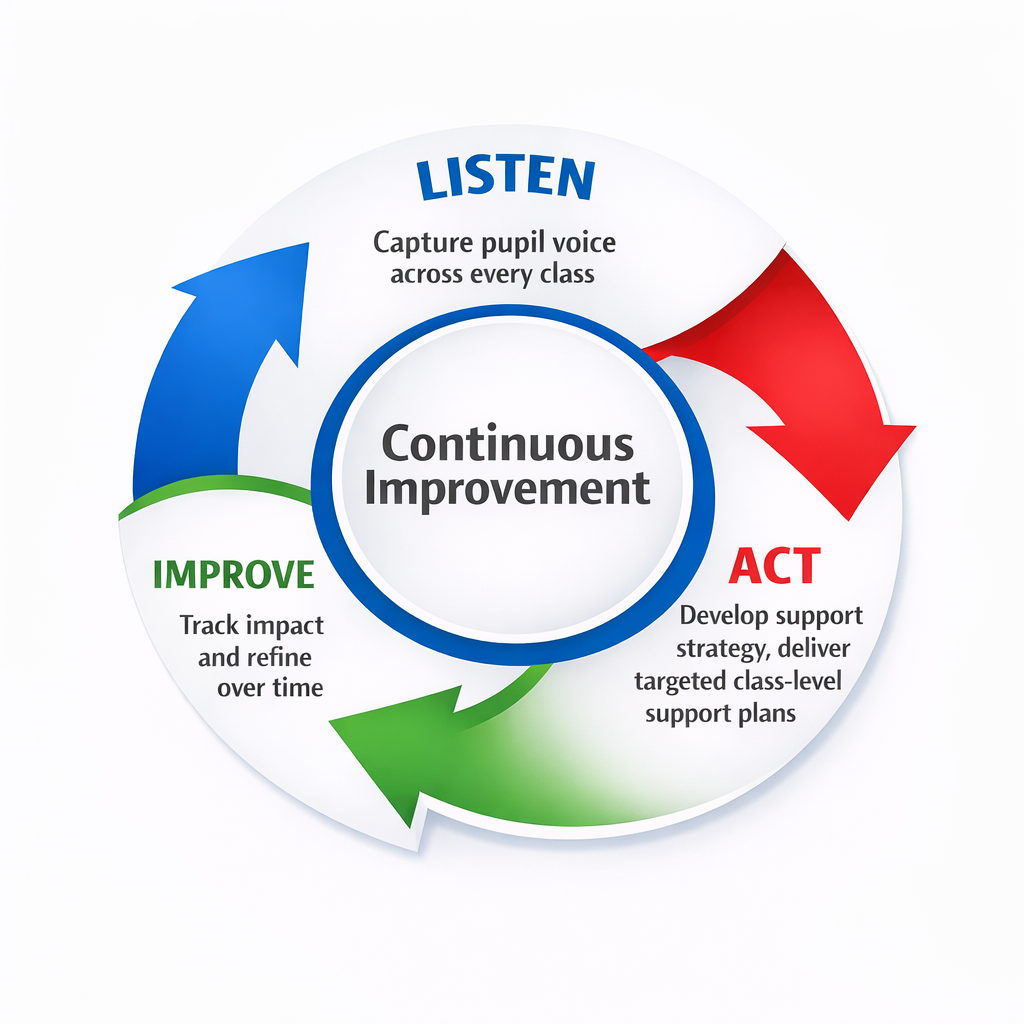
Insight alone is not enough. What matters is how it is used.
The YouCanSay framework transforms survey data into:
- Clear reports at school, year, and class level
- Comparisons across demographics and cohorts
- Identification of priority areas
- Trend analysis over time
Data → Insight → Action
What Does a Class Support Plan (CSP) Look Like?
1. Class Profile
- Overview of strengths and areas for development
- Comparison to school averages
2. Key Priority Areas
- 2–3 focus areas (e.g. self-esteem, relationships, emotional regulation)
3. Suggested Strategies
- Structured check-ins
- Group discussions
- Targeted activities
- Behaviour modelling
4. Staff Approach
- Consistent messages and expectations
- Shared approach across staff
5. Monitoring and Review
- Follow-up surveys
- Dashboard tracking
- Adjustments over time
Why CSPs Are So Valuable
- Highly cost-effective – scalable without individual assessment processes
- Targeted – based on real data
- Preventative – addresses needs before escalation
- Consistent – aligns staff approaches
- Impact-focused – measurable over time
A More Balanced System of Support
EHCPs and individual plans are essential and should remain central to supporting pupils with higher levels of need.
However, they work best when supported by a wider system that understands need across all pupils, prioritises support effectively, and provides context for individual provision.
School Support Strategies and Class Support Plans provide this missing layer.
Looking Ahead
There is a clear opportunity to strengthen early intervention, support schools in prioritising effectively, and improve outcomes for all pupils.
By combining population-level insight (EHCS, SSS, CSP) with individual-level support (EHCPs and individual plans), schools can deliver support that is both strategic and personalised where needed.