
LRQ: Transition Plus
Understanding pupils through the first two years of secondary school. What if pupils could tell us what they need before the school sees the consequences of them not being met?
Schools invest significant time, care and resources in helping pupils make the transition from primary to secondary education. Transition days, induction programmes, pastoral support and tutor activities all play an important role in helping children settle into their new school.
Yet an important question remains.
How well do schools really understand the needs of their new first-year pupils?
New pupils are often most in need of support at precisely the point when their new school knows them the least.
Relationships are still developing. Teachers are only beginning to understand personalities, strengths and vulnerabilities. Many pupils are making every effort to fit in, adapt to new routines and establish friendships. During this period, some emerging needs may remain hidden, not because schools are not looking for them, but because they have not yet had the opportunity to build a detailed understanding of every class.
This is where Life Readiness Transition (LRQT) begins.
Understanding pupils when schools know them least
The Life Readiness Transition Questionnaire has been developed to help schools understand the strengths, support needs and transition experiences of their new first-year pupils during the early weeks of secondary school.
The questionnaire gives every pupil the opportunity to reflect on their own strengths and capabilities across areas such as confidence, relationships, emotional management, problem-solving and seeking help. It also explores how pupils are experiencing the transition to secondary school.
The results are brought together at class or tutor-group level, providing tutors and pastoral staff with a clearer picture of the strengths within each group and the areas where additional support may be helpful.
Schools already have established processes for supporting pupils with identified and complex needs. Education, Health and Care Plans in England, plans developed through additional support for learning arrangements in Scotland, and other individual plans provide valuable information where they exist, helping schools understand and respond to the particular needs of those pupils.
However, many pupils will not have an individual support plan. This does not mean that they have no support needs. They may be experiencing difficulties with confidence, relationships, emotional regulation, problem-solving or asking for help that are not immediately visible and may not meet the threshold for individual or specialist intervention.
By including every pupil, the Life Readiness Transition Questionnaire helps tutors and pastoral staff identify the shared strengths and support priorities within the whole class or tutor group. This enables them to develop Class Support Plans with their pupils, combining questionnaire findings with their own professional understanding of the group.
The aim is simple.
To understand pupils before difficulties become established, enabling support to be planned earlier, targeted more effectively and reviewed over time.
But does transition really end after the first few weeks?
An increasing body of research suggests that it does not.
Instead, the move to secondary school should be viewed as the beginning of a much longer period of adjustment, with many of the most significant changes continuing throughout the first and second years.
This has important implications for schools.
Understanding pupils at the beginning of their first year is enormously valuable, but it may not provide the complete picture. Children's strengths, support needs and experiences continue to evolve, meaning schools benefit from continuing to build their understanding as pupils themselves continue to develop.
Transition is a journey, not an event
The University of Manchester's study Young People's Experiences of Starting Secondary School found that transition is highly individual. While many pupils enjoy the opportunities that secondary school brings, others experience uncertainty, changing friendships, increased anxiety and concerns about belonging.
Importantly, the study concludes that schools should not assume all pupils experience transition in the same way and recommends that young people themselves should play a greater role in shaping the support they receive.
This principle sits at the heart of the Life Readiness approach.
Rather than adults deciding what support is needed, pupils help schools understand the strengths and priorities within their own classes or tutor groups, enabling pupils and staff to develop Class Support Plans together and review whether those actions have made a positive difference.
Why support needs continue to change
Children's strengths and support needs do not remain static after they arrive at secondary school.
As pupils adapt to increasing academic expectations, larger peer groups, greater independence and changing social relationships, they often discover that skills which felt sufficient in primary school are now being tested in new and unfamiliar ways.
A pupil who previously felt confident asking for help may find secondary school more intimidating. Someone who had strong friendships in a small primary school may discover that building and maintaining relationships in a much larger environment requires new confidence and resilience. Others may begin to experience greater pressure managing their emotions, organising their work or coping with setbacks.
At the same time, the first two years of secondary school coincide with one of the most significant periods of physical, emotional and social development in a young person's life.
Many pupils are navigating puberty, changes in confidence, developing identities and evolving friendships. Because these changes occur at different times for different children, pupils may find themselves developing earlier or later than many of their peers, creating additional social and emotional challenges.
Life outside school also continues to shape children's development.
Experiences such as the loss of someone close to them, family changes, serious illness, moving home or other significant life events can influence how confident and capable pupils feel, often changing the way they perceive their own strengths and support needs.
As a result, pupils' understanding of themselves may continue to evolve throughout their first two years of secondary school.
Evidence suggests the greatest changes continue beyond the first year
Longitudinal research paints an even more compelling picture.
The Australian study Well-being Decline During Adolescence: School Transition as a Predominant Driver Beyond Age Progression followed young people before and after they moved to secondary school.
Its findings were striking.
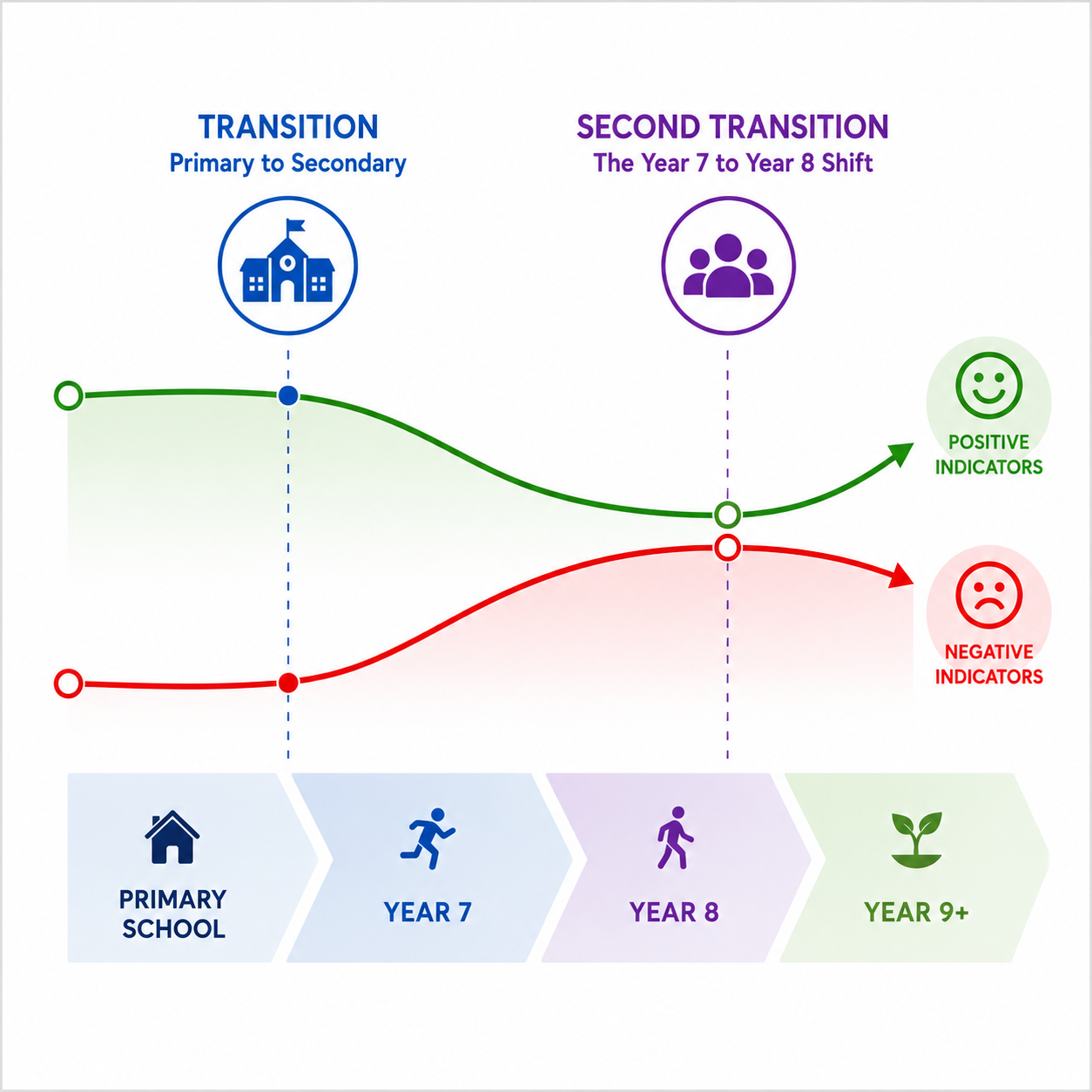
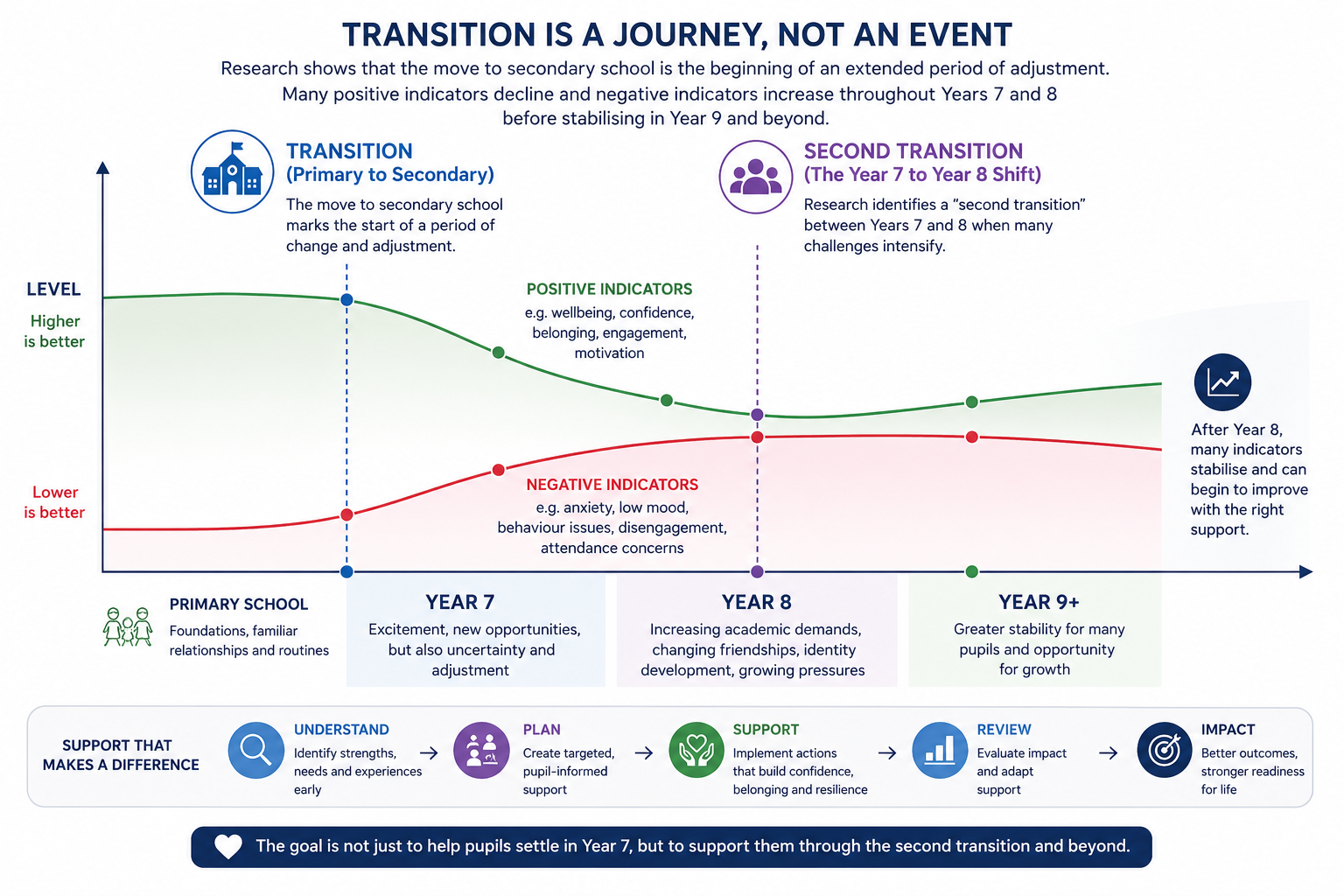
Across the first two years after transition, many positive measures declined while many negative measures increased. Importantly, these changes did not occur solely during the first few weeks of secondary school. Instead, they continued throughout the first and second years before many measures began to stabilise.
More recently, attendance research involving around 200,000 pupils identified the largest decline in attendance between Year 7 and Year 8 in England. These are the same year groups used in Wales and are equivalent to the move from S1 to S2 in Scotland. Researchers have described this as a “second transition”, suggesting that for many pupils the initial excitement of secondary school gives way to a new set of academic, social and emotional challenges during their second year.
Teachers themselves frequently describe the second year of secondary school as one of the most challenging. Pupils who appeared to settle well during their first year may become increasingly disengaged as expectations increase, friendships evolve and adolescence gathers pace.
Taken together, these findings suggest that transition should be viewed not as a single event, but as an extended period of development.
Introducing Life Readiness Transition Plus
If Life Readiness Transition helps schools understand pupils at the beginning of their first year, Life Readiness Transition Plus helps schools continue building that understanding throughout the remainder of the transition journey.
Rather than assuming pupils' strengths and support needs remain unchanged, Transition Plus recognises that children continue to grow, adapt and face new challenges throughout their first two years of secondary education.
Transition Plus combines:
- Life Readiness Transition (first year) to establish an early understanding of pupils' strengths, support needs and transition experiences.
- Tutor-led Class Support Plans that translate class-level insight into targeted, universal support developed with pupils themselves.
- Review questionnaires to evaluate whether that support has made a positive difference.
- Second-year Life Readiness assessment to understand how pupils' strengths and support needs have evolved throughout their first two years of secondary education.
- Longitudinal comparison that enables schools to identify emerging trends, evaluate the impact of support and plan the next stage of development.
Together these create a continuous cycle of:
Assess → Plan → Do → Review
rather than a one-off transition activity.
From understanding to action
Whole-school and year-group surveys provide valuable strategic insight into pupils' strengths and support needs.
However, support is delivered through staff working directly with classes and tutor groups.
Life Readiness Transition therefore focuses on providing class-level understanding, enabling the staff supporting each class or tutor group to understand its differing strengths and support needs and develop targeted, universal support through a Class Support Plan.
Importantly, this additional insight is achieved without increasing the burden of data collection. The same questionnaire provides whole-school, year-group and class-level understanding, allowing schools to combine strategic oversight with practical action.
Looking beyond the second year
For many schools, Transition Plus becomes the foundation of a broader Life Readiness approach.
By continuing the Life Readiness Questionnaire throughout the secondary years, schools can build a longitudinal understanding of how cohorts develop over time. Each year's Class Support Plan can be informed by the knowledge gained the previous year, creating an ongoing record of priorities, support delivered and the impact of that support.
The result is more than a transition programme.
It is a framework for understanding, supporting and evaluating pupils' development throughout their secondary education.
Insight → Action → Impact
Understanding children is only valuable when it leads to better support.
Better support should always be reviewed to understand whether it has made a difference.
That is the principle that underpins the Life Readiness approach.
Find out more
Contact us to learn how the Life Readiness Transition Questionnaire and Transition Plus can help your school, group of schools, local authority or regional education body understand pupils' strengths, identify support priorities and deliver targeted, cost-effective support.
Telephone: 01189 781078
Email: This email address is being protected from spambots. You need JavaScript enabled to view it.
Free demonstrations and example reports are available on request.
Let every pupil's voice be heard, and acted upon.