
Build Capacity to Support Wellbeing
Capacity is a child’s ability to understand and manage their emotions, build relationships, cope with challenges, and stay motivated to learn and grow.
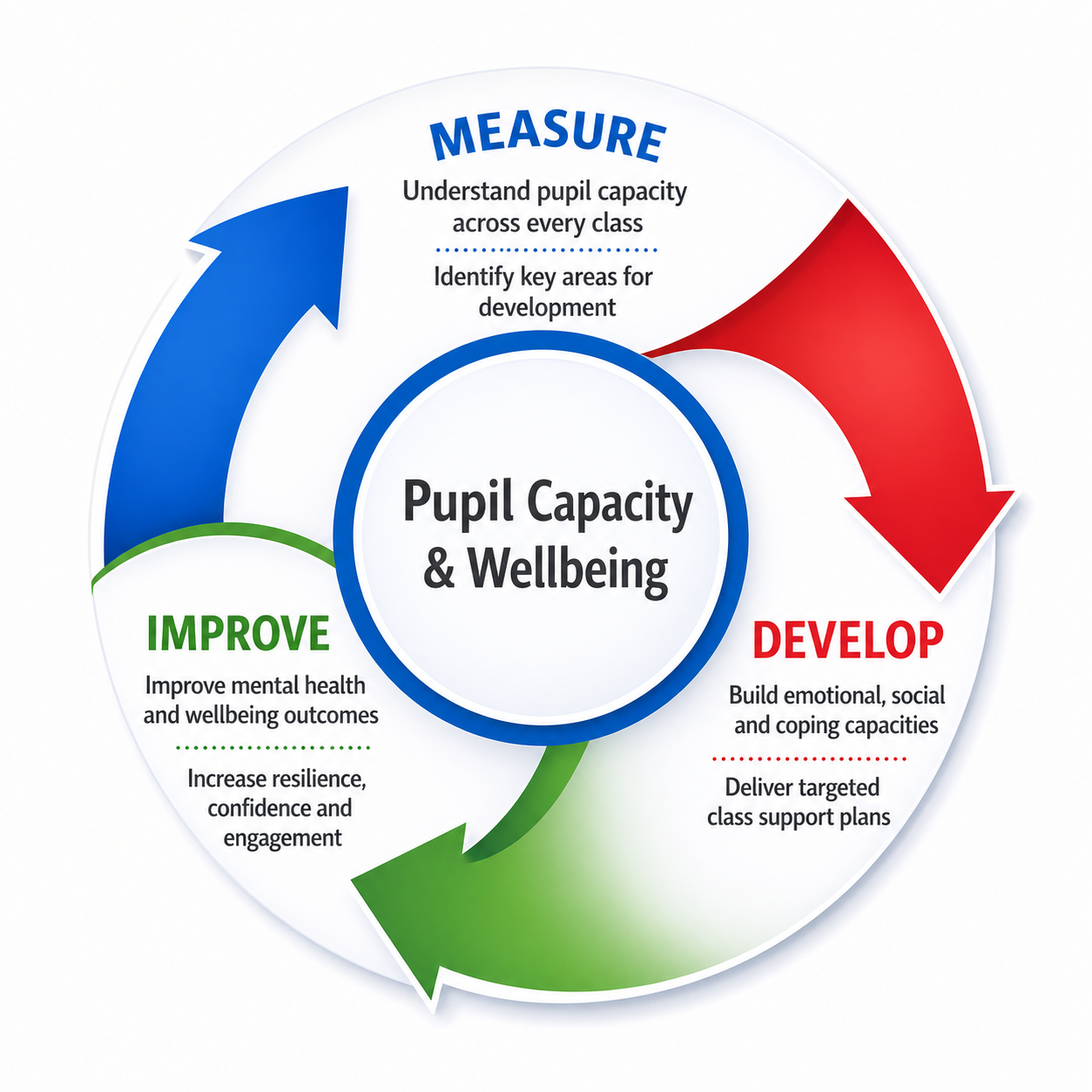
In recent years schools have increasingly used surveys to understand how pupils feel about their lives, their wellbeing, and their experiences in school. These approaches provide valuable insight into children’s emotions, behaviours, and perceptions.
They help answer questions such as:
- Do pupils feel happy or anxious?
- Do they feel safe and included?
- How do they experience school life?
This information is essential. However, it mainly describes what is happening for pupils.
There is another equally important question:
What are pupils able to do when challenges arise?
This is where the concept of capacity becomes important.
What do we mean by capacity?
Capacity refers to:
A child’s ability to understand, manage, and respond to their thoughts, feelings, challenges, and relationships.
In practical terms, capacity is a child’s ability to:
- Recognise and understand their own feelings
- Regulate emotions when they feel upset or overwhelmed
- Express themselves clearly and appropriately
- Understand and respond to others
- Cope when things go wrong or plans change
- Learn from past experiences
- Maintain relationships, even when things are difficult
- Stay hopeful, motivated, and purposeful
So when we talk about capacity, we are really asking:
Does this child have the skills and internal resources to cope, adapt, and thrive?
How is this different from other surveys?
Most surveys used in schools focus on experiences, feelings, behaviours, and perceptions of school life.
They tell us:
- how pupils feel
- what they experience
- how they behave
Occasionally, these surveys include questions that touch on capacity, such as knowing who to talk to or feeling able to ask for help. However, this is not usually their primary purpose.
Their main role is to describe outcomes, not to identify the underlying skills that shape those outcomes.
Capacity-based approaches are different.
They focus on the underlying abilities that influence how pupils feel, behave, and experience school.
This distinction is important.
Two pupils may both feel anxious. One may lack coping strategies. Another may struggle to recognise or express their feelings.
Without understanding capacity, both pupils appear similar. With capacity insight, their needs, and the support required, become clearer.
Can capacity be developed?
A key strength of a capacity-based approach is that these capacities are not fixed traits. They can be developed over time.
Children are not born with fully formed abilities to regulate emotions, manage relationships, or cope with challenges.
These capacities develop through:
- guidance
- modelling
- practice
- supportive environments
For example:
- A child learns to calm themselves through repeated support from adults
- Emotional understanding grows through conversation and reflection
- Coping skills develop through guided problem-solving
- Confidence builds through success and encouragement
This means that capacity is not just something to measure.
It is something schools can actively develop.
Why improving capacity matters
When capacity develops, the impact is seen across mental health and wellbeing.
Increasing capacity can lead to:
- Reduced emotional distress
- Improved behaviour and self-regulation
- Stronger and more stable relationships
- Greater resilience when facing challenges
- Increased sense of belonging
- Higher confidence and self-belief
- Improved engagement in school
- Better long-term wellbeing
This is because pupils are not just experiencing fewer difficulties, they are becoming better equipped to deal with them.
Wellbeing improves not only when problems are reduced, but when capacity is increased.
Capacity, Support, and Wellbeing Outcomes
| LRQ Capacity Area | What This Means in Practice | How Schools Can Support Development | Impact on Mental Health & Wellbeing |
|---|---|---|---|
| Self-Awareness | Recognising feelings, triggers, and body signals. | Emotion vocabulary, reflection time, modelling feelings. | Reduced anxiety, better emotional understanding. |
| Emotional Regulation | Managing emotions and staying calm. | Calming strategies, routines, adult support. | Fewer outbursts, greater emotional control. |
| Emotional Expression | Communicating feelings appropriately. | Safe spaces, sentence starters, modelling communication. | Reduced frustration, fewer conflicts. |
| Empathy | Understanding others’ feelings. | Discussion, modelling kindness, perspective-taking. | Stronger relationships, reduced conflict. |
| Relationships | Building and maintaining friendships. | Group work, inclusion activities, conflict support. | Greater belonging, improved social confidence. |
| Sense of Belonging | Feeling accepted, included, and valued. | Inclusive classroom culture, recognition, peer support. | Increased happiness in school, reduced isolation, improved engagement. |
| Coping & Adaptability | Managing change and setbacks. | Problem-solving, reflection, normalising mistakes. | Increased resilience, reduced anxiety. |
| Reflective Capacity | Learning from past experiences. | Reflection conversations, linking past to future choices. | Better decision-making, fewer repeated issues. |
| Seeking & Using Support | Asking for and accepting help. | Trusted adults, clear support routes, normalising help-seeking. | Reduced isolation, earlier access to support, increased feelings of safety. |
| Positivity & Hopefulness | Seeing positives and believing things can improve. | Highlighting progress, gratitude activities, reframing challenges. | Improved mood, reduced hopelessness, greater motivation. |
| Belief in Oneself / Self-Efficacy | Believing in ability to improve and succeed. | Encouragement, celebrating effort, scaffolded success experiences. | Greater confidence, willingness to try, reduced fear of failure. |
| Purpose & Direction | Having goals and feeling actions matter. | Goal setting, linking effort to outcomes, future-focused conversations. | Stronger motivation, sense of meaning, improved engagement. |
Measuring capacity in schools: The LRQ
The Life Readiness Questionnaire (LRQ) has been designed specifically to measure these capacity areas.
It provides insight at:
- school level
- year group level
- class level
This level of detail is important because it allows schools to move beyond general trends and understand which groups of pupils need support, and in what areas.
From insight to action: Class Capacity Support Plans
One of the key strengths of a capacity-based approach is that it naturally leads to action.
Using LRQ data, schools can develop Class Capacity Support Plans, or CSPs.
These plans identify priority capacity areas for a class, highlight specific strengths and areas for development, and provide a structured approach to targeted support.
What do CSPs involve?
A Class Capacity Support Plan typically includes:
- Key priority areas, such as emotional regulation, relationships, or coping skills
- Comparison to school averages
- Suggested strategies and actions
- Responsibility for support
- Timeframes and review points
Why CSPs benefit pupils
CSPs enable schools to:
- Target support where it is most needed
- Provide consistent approaches across staff
- Support all pupils, not just those in crisis
- Track improvement over time
- Link insight directly to action
Most importantly, they help schools move from identifying need to developing the capacity that underpins long-term wellbeing.
Final thought
Understanding how pupils feel is essential.
But understanding what they are equipped to deal with is just as important.
By focusing on capacity, schools are not just responding to current challenges. They are building the skills children need to navigate future ones.
Because long-term wellbeing is shaped not only by experience, but by the capacity to respond to it.